



Empowering Organizations To Achieve Emiratization With Our Latest Guidebook Download Now

Most of the AI we offer clients started as a fix for our own problems.

Recruitment at our scale means a lot of CVs, a lot of documents and a lot of follow-up. That's where we first put AI to work, in our own teams across the UAE and Saudi Arabia. This page explains how it grew from there.

How it happened

There was no single AI launch. It happened in steps, and we only took the next one once the last one was working.

Our own recruiters went first

AI took on sourcing and screening inside our recruitment teams. Recruiters kept the decisions.

01

What worked became products

The screening work turned into Hyrra.ai. We also built Forsatak for GCC national talent.

02

Then we automated our own sales

Two Salesforce Agentforce agents now find leads and handle early follow-up.

03

We opened it up to clients

TASC AI Solutions helps other companies do the same, one process at a time.

04

And we started backing founders

Quarter Zero co-founds AI-native companies with GCC founders.

05

Where you'll find our AI today

FOR EMPLOYERS

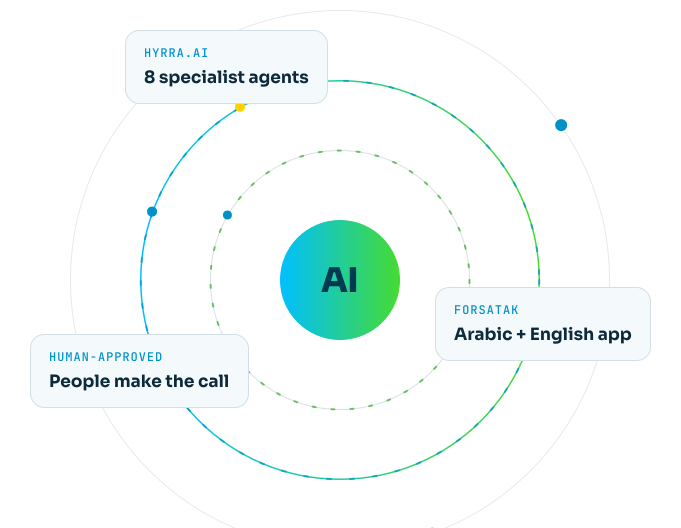
An AI recruiter built for hiring in the GCC. It runs eight specialist agents covering sourcing, screening, matching, interviews, candidate messages and compliance checks such as visas and Saudization.

It sits on top of the ATS you already use. If a role needs a person, our recruiters pick it up.

Visit hyrra.ai →

FOR GCC NATIONALS AND EMPLOYERS

A job platform just for GCC nationals. Candidates use the app, in Arabic or English, to find roles and apply.

Employers get a free account to post jobs and search verified profiles. It's a practical help with Emiratisation and Saudization hiring.

Visit forsatak.com →

FOR BUSINESSES

Our AI consulting service. We look at one process with you, build an agent for the parts where it makes sense, and plan how your team works alongside it. Final decisions stay with your people.

About TASC AI Solutions →

FOR FOUNDERS

Our venture studio. We co-found AI-native companies with GCC founders and help them reach their first customers. The name comes from a simple idea: before Q1, there's Q0.

Visit Quarter Zero →

Two examples of how we'd approach a project

These are illustrative scenarios, not client stories. We wrote them up to show
how we scope the work and what we'd measure.

Scenario 1 Corporate services

A visa and licence team stuck chasing documents

TODAY
Client
→
Operations
→
Done
Missing document, ask again
PROPOSED
Client
→
Checked at
submission
→
Operations
→
Done

Say a corporate services provider asks us to automate form filling so it can handle more cases. When we follow cases from start to finish, the real hold-up often sits earlier: documents arrive incomplete and go back and forth with the client.

So the change would happen at the start. Documents get checked as they're submitted, and people can fix problems straight away. Staff still deal with anything unclear.

What we'd measure. Cost per completed case. Along the way, how often documents are requested again, and whether any wrong ones slip through.

Scenario 2 B2B sales

A sales team that wants more outreach

TODAY
→
Shared
inbox
→
Customer
Many stall
PROPOSED
→
Named owner
for each one
→
Next step
suggested
→
Customer

Say a B2B services company wants AI to send more outreach. Before adding volume, we'd look at won, lost and stalled enquiries and talk to the people working them. Good leads often stall because nobody clearly owns them, or a follow-up gets missed.

If that's what we find, we'd build a workflow that gives every enquiry an owner and suggests the next step. Pricing and negotiation stay with the sales team.

What we'd measure. How many qualified enquiries become paying customers. Faster replies and more meetings are good signs, but they don't count as success on their own.

What stays with people

Some decisions shouldn't be handed to software. In our own operations, and in anything we build for clients, a person approves hiring decisions, payments, sensitive exceptions and any change to what an agent is allowed to access.

Before anything goes live, we agree where the data is stored and processed. We also keep a record of what each agent did and who signed it off.

05 FAQ

Questions we
often get

Usually, yes. We build around what you have, whether that’s an ERP, CRM, HR system or ATS, rather than asking you to replace it. In the first conversation we ask which systems the process touches and how they connect today, so integration is scoped before any build starts.

That’s agreed with your IT and compliance teams before anything goes live. We map what data the agent needs, where it will be stored and processed, and which cross-border rules apply, including UAE and Saudi data protection law. If something can’t leave your environment, we design around that.

Each agent gets defined permissions: which systems it can read, which it can act on, and which actions need a person’s approval. Any change to those permissions is signed off by a person too. Every action is logged, so your team can see what the agent did and who approved it.

No. We handle the build and can support it once it’s running. From your side we need someone who owns the process, an IT contact for access and integration, and a few people who can check the agent’s output while we test it.

It depends on the process and how many systems it touches, so we don’t quote a timeline before the first call. We start with one process and test the agent on real past examples. We only widen its use once it’s meeting the measures we agreed at the start.

That’s the Operate part of our service. We keep tracking results against the agreed measures, adjust the workflow where needed, and help plan how roles in your team change around the agent. Your people keep the final decisions throughout.

If the steps are fixed and the data is clean, rules-based automation or a change to your existing system is often cheaper and easier to maintain. AI earns its place when the work involves reading varied documents, emails or messages. If we think you don’t need it, we’ll say so.
06 REQUEST A PROPOSAL

Want to build an AI solution for a process in your organisation?

We can help.

Tell us which process you have in mind and how it runs today. A member of our AI team will read it and come back to you to talk it through.

If we think ordinary automation would do the job better, we'll tell you.

01

You send the request.

A few lines is enough to start.

02

We have a first call.

We ask about volumes, systems and who owns the work.

03

You get a proposal.

Scope, what we'd measure and what it would take.

Let's Connect

Contact Details